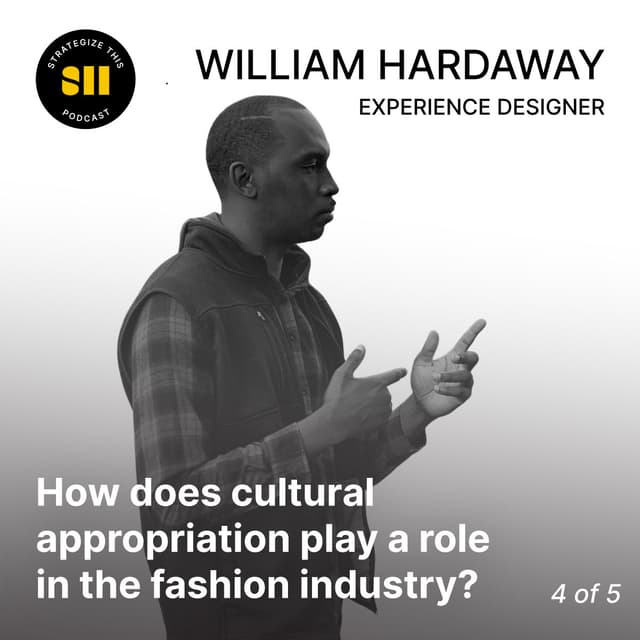
How does cultural appropriation play a role in the fashion (and design) industry? | William Hardaway (4 of 5)
William Hardaway explores how cultural appropriation shows up in fashion and design, arguing that intent does not excuse impact. He reveals how rethinking design thinking with identity and acknowledgement can prevent brands from causing unintentional harm.
Show Notes
In This Episode
William Hardaway, who works at the intersection of social justice and design thinking, tackles the question of how cultural appropriation plays a role in the fashion industry. Will explains that whether something is appropriation is not determined by the creator's intent — it is determined by those receiving it. He shares how he has reimagined the design thinking process to center identity and acknowledgement before any creative work begins.
Key Takeaways
- Appropriation is defined by those who receive it, not by those who produce it — intent does not excuse impact
- Profiting from cultural elements without permission or understanding is at the core of appropriation, especially when sacred traditions like indigenous patterns and headdresses are involved
- Traditional design thinking is flawed because it assumes a blank slate — Will's approach adds identity and acknowledgement as the first steps before ideation
- If your team lacks representation, at minimum acknowledge the gap and build checkpoints into the process to account for groups you are designing for but do not belong to
About William Hardaway
William Hardaway works at the intersection of social justice and design thinking. After working in each field separately for over a decade, Will combined them to drive change in industries that unite people and cross borders.
Connect
- Hosted by Adam Matossian and Alicia Jones
- Listen on Spotify | Apple Podcasts | Amazon Music